
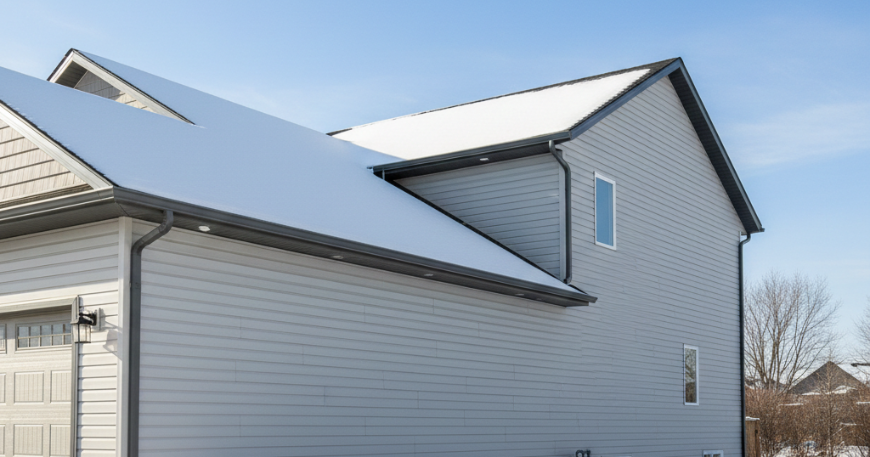
As the snow starts to fall in Toronto and the surrounding areas, homeowners have to deal with a special set of problems. The harsh Canadian winter isn’t just hard on us; it’s also a tough test for your home’s first line of defense: your eavestroughs (gutters) and siding.
We at Ontario Siding and Gutters have seen how freeze-thaw cycles can cause a lot of damage to homes. Here is our expert advice on how to keep the outside of your home safe until the spring thaw.
1. The Gutter Gauntlet: How to Stop Ice Dams
Heavy snow followed by a little thaw in the Greater Toronto Area can cause the dreaded “ice dam.” When heat leaves your attic, it melts the snow on your roof. This water flows down to the cold eavestrough, where it freezes again and forms a block of ice that stops more drainage.
Before the deep freeze, make sure your gutters are completely clear of leaves and other debris from the fall. When gutters get clogged, they hold water, which freezes and becomes heavy ice that can pull your eavestroughs right off the fascia board.
If you see big icicles forming, it’s a sign that your insulation isn’t good or that something is blocking it. Don’t try to break the ice yourself; you could hurt the shingles and the gutter.
2. Siding Survival: Cold and Moisture That Breaks
The cold changes how your siding works, whether it’s vinyl, aluminum, or fiber cement.
Expansion and Contraction: Siding expands and contracts when the temperature changes quickly. If the panels were put on too tightly, they could bend or break in the cold.
Impact Awareness: When it’s very cold, vinyl siding can break easily. When you’re shoveling snow or using a snowblower near the house, be careful. A small bump can cause a crack that lets moisture get behind the panels, which can cause mold or rot.
3. Taking care of the downspout
In cities and suburbs, where protecting the foundation is important, proper drainage is very important.
Clear the Exit: Make sure your downspout extensions are sending water at least 4 to 6 feet away from your foundation. If the exit point is buried in a snowbank, the water will freeze the whole pipe and maybe even break it.
4. Inspections After the Storm
Take a quick walk around your house after a big winter storm. Check for:
- Gutter sections that are sagging.
- Siding panels that aren’t fastened down are shaking in the wind.
- Water stains on the siding (this means there is a leak in the ice dam).
Helping Your Community
To keep a home in Ontario, you need to know the area well. Ontario Siding & Gutters is here to help, whether you live in the city or the suburbs. If you take small steps now, you could save thousands on emergency repairs in the spring.